The Rise of Hybrid Offices in Pune: What’s Driving the Trend?
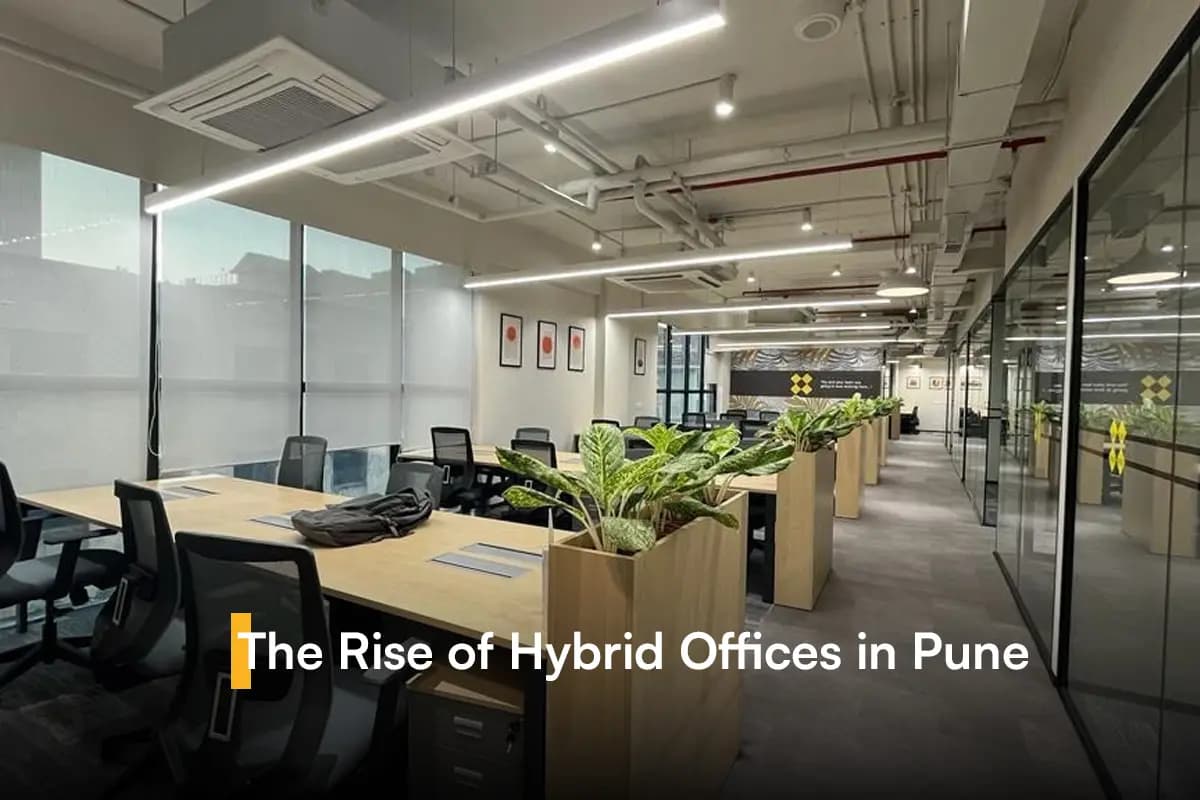
The traditional office model is evolving. In Pune, a city powered by IT, startups, and multinational corporations, hybrid offices have moved from experiment to permanent strategy.
This transformation is not a temporary reaction — it is a structural shift in how businesses operate and how employees choose to work.
The Trigger: A Pandemic That Redefined Work
The COVID-19 pandemic forced companies across Pune to adopt remote work overnight. What began as a crisis response quickly became a large-scale productivity experiment.
Contrary to long-standing assumptions, businesses discovered that teams could perform effectively without being physically present in the office five days a week.
This realization reshaped corporate real estate strategies across the city.
The Talent Factor: Flexibility as a Competitive Advantage
Pune’s job market, especially in IT hubs like Hinjawadi and Kharadi, is intensely competitive. Skilled professionals now prioritize flexibility alongside salary and career growth.
Companies offering hybrid models have a significant advantage in:
- Talent attraction
- Employee retention
- Reducing burnout
- Improving job satisfaction
In many cases, flexibility has become a non-negotiable workplace benefit.
The Transformation: Offices as Collaboration Hubs
The purpose of the office has shifted from daily desk work to meaningful collaboration and culture-building.
1. Collaboration-Centric Design
Modern office layouts now emphasize:
- Meeting rooms and brainstorming zones
- Huddle spaces
- Breakout areas
- Community-driven spaces
Instead of rows of fixed desks, offices are becoming destinations for teamwork and innovation.
2. Growth of Coworking & Managed Offices
Hybrid work has accelerated demand for flexible workspaces. Coworking operators in Pune are expanding rapidly, offering plug-and-play offices that allow businesses to scale up or down without long-term lease commitments.
This flexibility aligns perfectly with evolving corporate strategies.
3. Employee Wellbeing & Commute Reduction
Pune’s traffic corridors — whether Katraj to Hinjawadi or Pimpri to Kharadi — can be time-consuming and stressful.
Hybrid models reduce commute frequency, giving employees more personal time and improving work-life balance.
The Core-and-Flex Model
Many companies are adopting a core-and-flex strategy — maintaining a central headquarters in prime micro-markets while complementing it with smaller satellite offices in suburban zones such as Wakad, Ravet, or Keshavnagar.
This decentralized approach reduces operational risk and increases agility.
Challenges Ahead
The hybrid model is not without challenges. Businesses must address:
- Maintaining company culture
- Ensuring remote employee inclusion
- Implementing secure technology systems
- Measuring performance fairly
However, with the right policies and digital infrastructure, these challenges are manageable.
The Bigger Picture
The rise of hybrid offices reflects a broader shift toward flexibility, sustainability, and human-centric design in Pune’s commercial real estate market.
This is not a temporary trend — it is the new normal. Businesses that adapt will benefit from stronger talent pipelines, optimized real estate costs, and more resilient operations.
Pune’s commercial future is not about bigger offices — it is about smarter ones.